
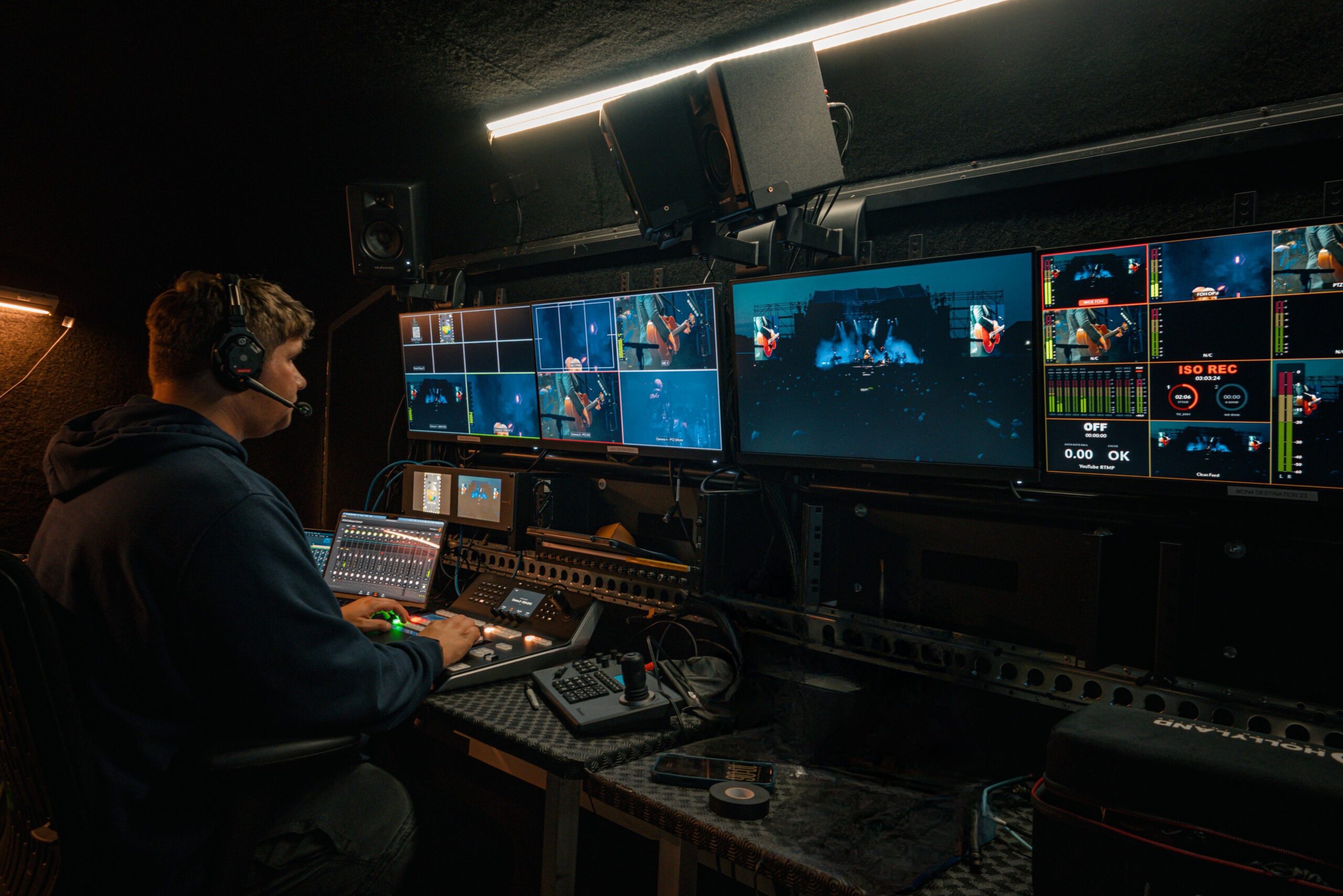
Choosing a live production company comes down to twelve questions, and almost none of them are about cameras. The things that separate a £1,200 quote from an £11,000 quote for the same event are crew, connectivity, redundancy, insurance and scope. Ask about those directly and the price difference usually explains itself within ten minutes.
Key Takeaways
- The biggest hidden variable in any quote is how many operators are included and what they are doing
- Venue WiFi is the most common single cause of a failed live stream
- Ask what happens when something breaks, not whether it will
- Differences between quotes are usually scope rather than margin
- A supplier who names the risks in your specific event has actually thought about your event
Why Three Quotes for the Same Job Look Nothing Alike
This is the situation most people find themselves in. Three suppliers, three wildly different numbers, and all three documents say something close to “multi-camera live streaming”. There is no obvious way to tell whether the cheap one is a bargain or a disaster, and no obvious way to tell whether the expensive one is buying you anything you need.
The gap is real. It is almost never in the cameras, because everyone is using broadly similar equipment. It is in how many people are there, where the internet is coming from, what happens when something fails, and how much of the job continues after the event ends.
The twelve questions below surface all of that. Ask them of everyone you are considering, including us.
The Twelve Questions
1. Who is operating the equipment on the day?
This is the single biggest cost difference between quotes and the one nobody volunteers. A quote can cover anything from equipment delivered for your own team to run, through to a full crew of operators who use that kit every week.
Both are legitimate. Which one you need depends entirely on whether you have people who can run it. The problem is assuming you are buying one and discovering at the get-in that you bought the other. Ask how many operators are included and what each of them is doing.
2. Where is the internet coming from?
Ask this before anything technical. If the answer is “the venue’s WiFi”, you have found the weak point in the whole job.
Venue internet is specified for guests checking email, and it is shared with everyone else at your event including the card machines and the ticket scanners. A supplier who brings their own bonded cellular or satellite uplink has removed the most common single cause of a failed stream. A supplier who plans to ask reception for the WiFi password on the morning has not.
3. What happens if a camera dies mid-event?
You are not testing whether they carry spares. You are testing whether they have thought about it at all.
A good answer describes what the operator does in the next thirty seconds, what the director cuts to, and where the replacement body comes from. A vague answer about using reliable equipment means the question has never been considered, which means it will be considered for the first time during your event.
4. Is the recording backed up separately from the stream?
Streaming and recording are different processes and they fail independently. If the recording only exists as a capture of the outgoing stream, then anything that interrupts the stream also puts a hole in your archive.
For an event that can never be repeated, a graduation or an AGM or a wedding, ask specifically whether recording runs on a separate path.
5. Who is actually turning up?
Almost every company in this industry uses freelancers, including us, and there is nothing wrong with it. Standing crews are uneconomic for work that clusters into a few months of the year.
What matters is whether it is the same freelancers repeatedly, whether the company has worked with them before, and whether anyone senior is on site. Ask how many of the crew on your job have worked with them in the last twelve months. Hesitation is informative.
6. Can I see something you shot in a room like mine?
Showreels are edited to flatter. Ask instead for full footage from a comparable event: same rough scale, same kind of room, same type of content.
A conference in a low-ceilinged hotel suite is a completely different job from a festival main stage. A company brilliant at one can be entirely ordinary at the other, and the showreel will not tell you which.
7. What insurance do you carry, and can I see it now?
Public liability and employers’ liability at minimum. Your venue will almost certainly ask for certificates, along with a risk assessment and method statement.
The test is not whether they have them. It is how quickly they arrive. A company that sends them with the quote has done this before. A company that takes a week has not, and you will be chasing paperwork in the fortnight you can least afford it.
8. What exactly is in the quote, and what is extra?
Get it itemised. Cameras, crew, connectivity, graphics, recording, travel, accommodation, overtime, post-production.
The gap between two quotes is frequently not price at all, it is scope. One includes an edited highlights package and a captioned recording, the other stops the moment the stream ends. Ask specifically what happens if the event overruns by an hour, because live events overrun and the answer varies enormously.
9. Who will I actually be talking to on the day?
Find out whether the person selling you the job is the person delivering it. Not a problem either way, but you need to know.
Get a name and a mobile number for whoever can make decisions on site. Discovering at the get-in that your contact is elsewhere and nobody present can authorise a change is a bad afternoon.
10. Have you worked in this venue before?
Useful if yes, not disqualifying if no. What matters more is the follow-up question: what will they do about it?
A supplier who has never worked your venue and proposes a site visit is in a stronger position than one who has been twice and is working from memory. Every venue has a quirk. The question is whether they intend to find yours before the day rather than during it.
11. What do you need from me, and by when?
This tells you more about how organised a supplier is than anything else on the list.
Someone who has run a lot of events has a clear list ready: running order, venue technical contact, brand assets, name spellings, slide deck deadline, sound desk contact. A supplier who says “just send us the details closer to the time” is a supplier who will be asking you urgent questions on the morning of your event.
12. What could go wrong with my specific event?
Ask this one last and pay close attention to the answer.
A supplier who says nothing will go wrong is either inexperienced or managing you. Everyone who has done this for a while has a list: a difficult venue, a tight get-in window, an unrealistic running order, a bandwidth constraint, a stage layout that fights the camera positions. Someone who names the risks in your job has thought about your job rather than sending you a template.
Two Things That Are Not Reliable Signals
Company size
Headcount tells you very little. A four-person operation with owned kit and a settled freelance network can comfortably outperform a twenty-person company subcontracting your job to whoever happens to be free that week. Ask about the crew on your event, not the number of faces on the About page.
Client logos
A logo on a website might represent a full multi-camera broadcast or one operator sent as a subcontractor for an afternoon. Both are legitimate work and only one of them tells you anything about capability. Ask what they actually did for that client. Most will tell you straight, and the ones who become vague have answered the question anyway.
Where dwmedia Sits on All This
In the interest of taking our own advice, here are our answers to our own questions.
For live events we crew the job, because that is where the risk sits and it is the part we will not compromise on. We bring our own bonded connectivity and satellite as standard rather than pricing it as an extra. We own our core camera and switching equipment rather than cross-hiring it. We are a small owner-led company working with a regular freelance crew network, which we say upfront because it matters to some buyers. Insurance and RAMS go out with the quote.
And if your job is genuinely better served by a different kind of supplier, we would rather tell you than take it.
If you are planning an event and want straight answers to all twelve of these, book a discovery call. If you are still working out budget, our guide to what live streaming actually costs covers what drives the number.
Frequently asked questions
What is the difference between an AV company and a live production company?
An AV company typically handles the room: sound reinforcement, staging, lighting and screens for the people physically present. A live production company handles the broadcast: cameras, vision mixing, graphics and the stream going out to a remote audience. Plenty of suppliers do both, and plenty of events use one of each working alongside one another. Confusion between the two is a common cause of gaps in a quote, so establish early which one you are actually buying.
How far in advance should I book a live production company?
For a straightforward single-room event, several weeks is usually workable. For anything in September to November, which is AGM and conference season, or for jobs needing BSL interpretation, start months out. Short-notice bookings do happen, frequently when a venue’s internet turns out to be unusable during rehearsals, but you have far less choice of supplier.
Is it cheaper to use the venue’s in-house AV supplier?
Sometimes, and they will know the room, which has real value. But in-house suppliers are often strong on sound and staging and weaker on broadcast, and some venues charge a fee if you bring an external supplier in. Get both quotes, compare them line by line rather than on the total, and check specifically what the venue charges for outside suppliers before assuming in-house is the cheaper route.
Should I ask for references?
Yes, but ask for a specific kind. A reference from a client whose event resembles yours is worth ten generic testimonials. Better still, ask for a client whose event had a problem, and find out how it was handled. Every supplier who has been doing this a while has one of those, and how they talk about it tells you a great deal.
What is a realistic budget for streaming a one-day conference?
Too variable to give a single figure honestly, because camera count, crew numbers, day length, connectivity and post-production deliverables all move it substantially. The useful approach is to decide what the stream needs to achieve first, then get itemised quotes against that rather than asking for a price and comparing totals that describe different jobs.