Town Hall & All-Hands Production | Internal Comms | dwmedia

Town hall and all-hands production by dwmedia
Town Halls & Internal Comms

Ninety seconds
to keep them.

That is roughly how long an all-hands has before the other tab wins.

Town halls, all-hands and quarterly updates produced properly and streamed to wherever your people actually are. Multi-camera, on-brand, and set up so remote staff are participants rather than spectators.

Attendance is not
the number that
matters.

Everyone reports how many people joined. Almost nobody reports how many were still there at the end, which is the number that tells you whether the message landed.

The drop-off is rarely about content. It is a single fixed camera on a stage, audio recorded from the back of a room, slides pointed at rather than cut in, and a stream that stutters when the building gets busy. Ten minutes of that and people are answering email with the tab open.

Produce it properly and the curve changes shape. Same CEO, same slides, same message. People just stay.

Internal broadcasts people actually watch.

dwmedia produces and streams town hall meetings, all-hands, quarterly business updates, leadership briefings and internal training broadcasts for organisations across the UK. The audience is almost always split: some people in a room, most people at desks, at home, on a site or on a shift somewhere else. That makes internal comms a hybrid production problem before it is a filming one.

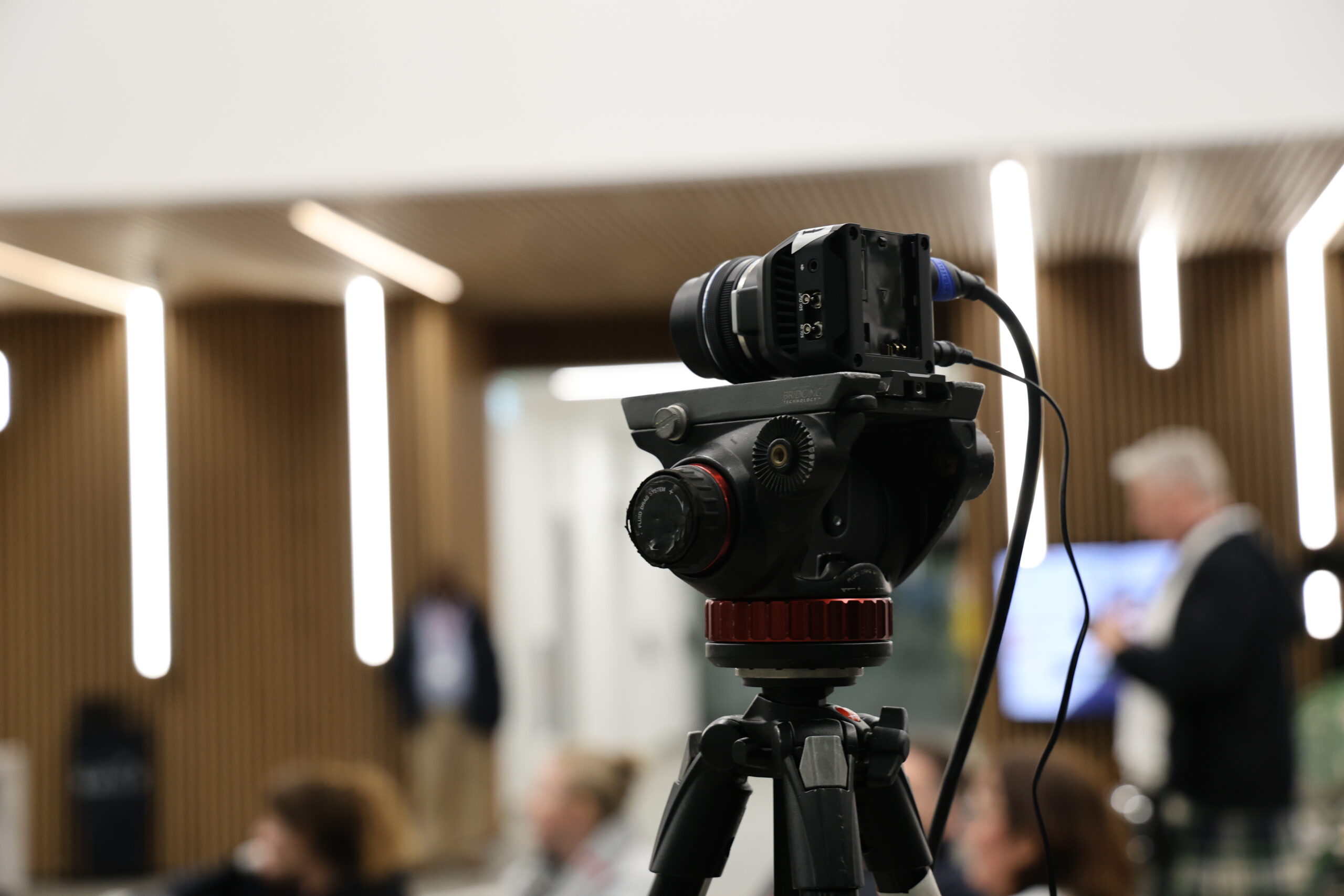
The technical requirements are not complicated, which is exactly why their absence is so noticeable. Multiple cameras so the picture changes and attention holds. Clean audio taken as a feed from the desk rather than a microphone at the back of the room. Slides and video roll-ins cut into the broadcast at source quality instead of filmed off a projection screen. Named lower thirds so people watching remotely know who is talking. Your brand rather than a stock webinar frame. None of it is exotic. All of it is missing from the version most organisations produce internally.

Why recurring works better than one-off

This is the part worth understanding before you book anything. A single town hall is a setup problem: unfamiliar room, unfamiliar kit, a leadership team who have not done it before, and a comms manager absorbing ninety minutes of anxiety on the day. A quarterly commitment is a different animal. The format gets locked after the first one, the crew learn your room and your people, the graphics package is built once and reused, and the per-event cost drops well below four separate bookings. It also means the CEO is not being asked to perform in an unfamiliar setup every three months.

Most of the internal comms work we do is recurring, and it is recurring because it worked the first time rather than because anyone was locked into a contract.

Reach, access and what happens afterwards

We stream into Teams Live Events, Zoom Webinar, Vimeo, YouTube or a private platform, publicly or behind authentication, and to more than one destination where part of your audience is internal and part is external. Recordings come back quickly for people on different shift patterns, with short highlight cuts available for follow-up communications. If you have deaf or hard of hearing employees, or you publish recordings internally for any length of time, our captions and BSL work applies here as well. dwmedia works UK-wide from Ashington, Northumberland.

What changes

Three things that
move the number.

Multi-camera town hall coverage
01
The picture changes
Wide, close and audience, cut live by an operator watching the room. A static shot is the single biggest cause of drop-off and the easiest thing to fix.
Branded graphics for internal broadcast
02
It looks like your company
Your brand, your colours, named lower thirds, slides cut in at full quality. Not a generic webinar template with a logo in the corner.
Remote participation in an all-hands meeting
03
Remote staff take part
Questions moderated and passed to the host properly, dial-in speakers brought in cleanly, polls integrated. Not a chat window nobody is reading.
Internal communications production setup
What we bring

Broadcast standard
in an office.

Low ceilings, strip lighting, glass walls and a projector. That is the room we are usually working in, and that is what the package is built for.

Multi-camera with a live mix
Cut by an operator responding to what is happening, not switched on a timer or left on a wide.
Radio mics and desk feed
Direct audio where a system exists, our own where it does not. Bad sound loses an audience faster than bad pictures ever will.
Slides and video at source quality
Taken as a clean feed and cut into the broadcast. No keystone, no moiré, no camera pointed at a screen.
Graphics package built once
Titles, lower thirds and holding cards in your brand, reused every quarter so each event costs less than the last.
Our own connectivity
Bonded cellular, so the broadcast is not competing with your own staff’s Teams calls and IT do not need to open anything.
Recording and highlight cuts
Full recording back quickly for shift workers and absentees, plus short cuts for follow-up comms.
FAQs

Common questions.

Sometimes you should not, and we will say so. A twenty minute update to sixty people, where the current setup is holding attention, does not need a production company. Bring us in when the audience is large enough that drop-off costs you something, when there is an announcement that genuinely has to land, or when the quality has started to look out of step with everything else you publish.
Yes. We feed a produced multi-camera broadcast into Teams Live Events, Zoom Webinar, Vimeo, YouTube or a private platform, and to more than one at once where some of the audience is internal and some external. Your people keep using the tool they already know, the picture and sound just get considerably better.
Meaningfully, yes. The graphics package is built once and reused, the crew stop needing a full brief, the room is known and the format is locked after the first event. Per-event cost on a quarterly commitment sits well below four separate one-off bookings, and the events get better as well as cheaper because nobody is improvising.
No. We bring bonded cellular connectivity, so there are no firewall exceptions, no bandwidth request and no unfamiliar equipment on your corporate network. It also means the broadcast is unaffected when three hundred employees join a Teams call at the same time, which is exactly when your town hall is happening.
Yes, and it is worth setting up properly. Questions can be moderated and handed to the host rather than scrolling past unread, which turns remote staff into participants. Polls, reactions and upvoting can be integrated depending on your platform. Decide this early, because it changes how the session is run rather than just how it is filmed.
Yes. A main room broadcasting out with other offices joining live, or speakers presenting from different locations into one mix, are both routine. The thing to plan for is who is on camera where, and whether remote sites need to be seen by the main room as well as the other way round. Worth a conversation early because it affects the kit list.
It varies with room size, camera count, duration, whether there is an in-room screen requirement and whether it is one-off or recurring. A single-room quarterly update is a very different figure from a full-day leadership conference with breakouts. Our cost guide covers the drivers, and a short call will get you a real number.
Get started

Town hall
coming up?

Tell us the room, the audience size and how often it happens. We will come back with a plan and a quote.

Get an estimate